Search for Tiny Desk AI, a Tiny Desk AI generator, or a Tiny Desk AI video, and you land in the same place: a fourteen-to-twenty-second office concert, a huge laugh, a saxophone, and the chorus of a 1982 funk record. The names vary. Some people type Outstanding Tiny Desk AI. Others type Charlie Wilson Tiny Desk AI. They are looking for one format, not a general music-video tool.
This guide separates the real concert from the meme, then walks through how a dedicated generator builds the clip. The worked example is trytinydesk.video, an independent browser tool that casts one to five photos into a 14-second vertical video. It is a fan-made parody product. It is not NPR, not Tiny Desk Concerts, not Charlie Wilson, and not The Gap Band.
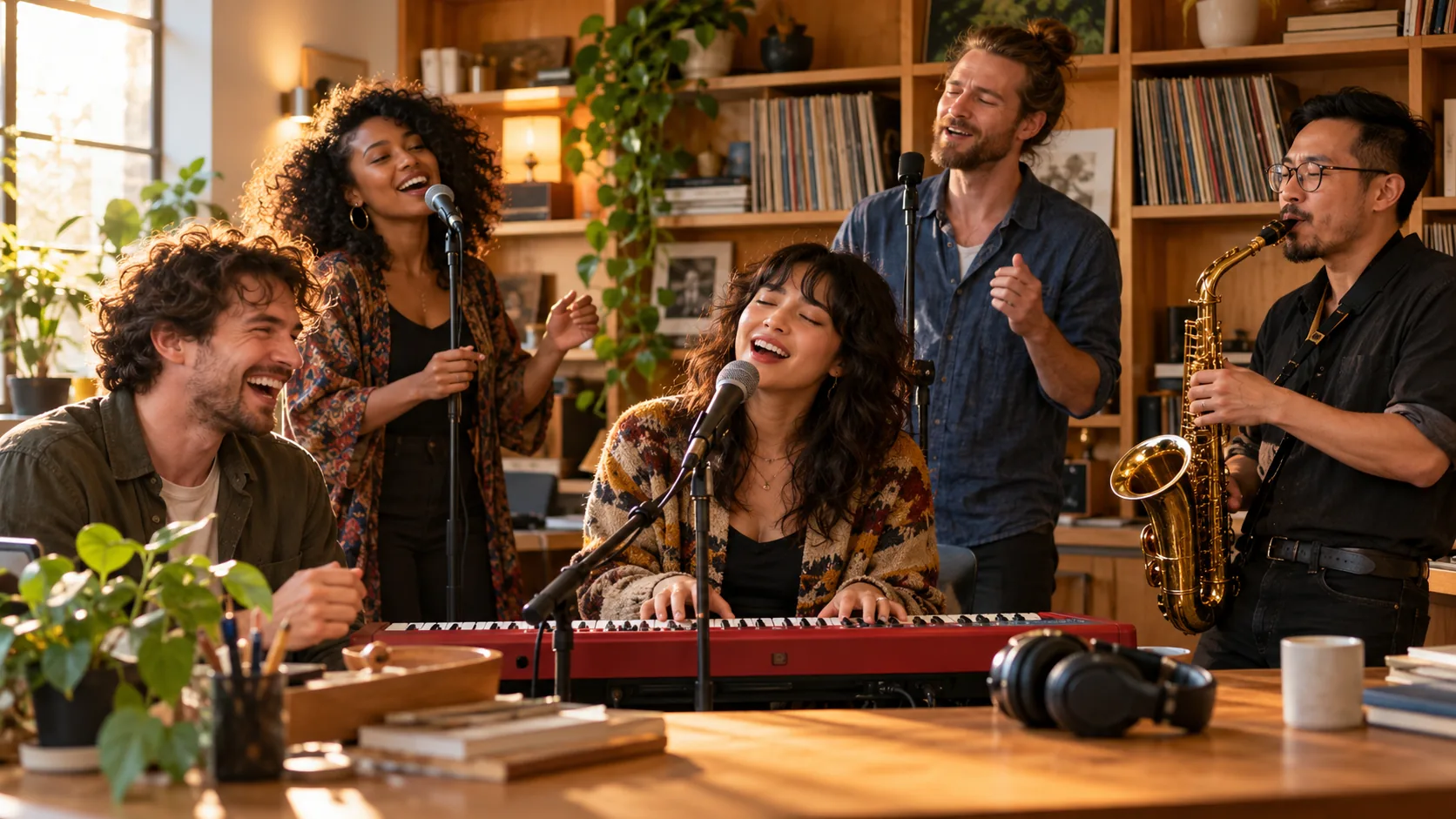
The Concert People Are Quoting
The source performance is a real NPR Music Tiny Desk concert. NPR published Charlie Wilson's set on June 5, 2023, during Black Music Month. Bobby Carter produced it. Wilson, then more than fifty years into a career that started with The Gap Band, played in the NPR office with a full band and a stack of backing singers.
The set list, as NPR printed it, runs through "Charlie, Last Name Wilson," "Computer Love," "There Goes My Baby," "I'm Blessed," "Yearning for Your Love," a verse from "Sweet Yamz," and, last, "Outstanding." NPR's concert page also records the spoken stretch in the middle, where Wilson describes addiction, homelessness, and twenty-eight years of sobriety. Rolling Stone's write-up the same day called the performance a set that "takes the Tiny Desk to church," and noted that "Outstanding" closed the show. The song is from The Gap Band IV, released in 1982, when Wilson sang lead with his brothers Ronnie and Robert.
NPR's musician credits name Nick Wilczynski on saxophone, Cordell Walton as music director and keys, and a vocal section of Jor'el Quinn, Leah Thompson, Gia Wyre, Dodie, and Angel Hines, among others. That detail matters later. The meme does not restage the whole concert. It keeps a short closing stretch in which a small group, a laugh, and a sax solo are doing almost all of the visual work.
Tiny Desk itself is older than this one episode. Bob Boilen and NPR Music started the series in 2008 as a desk-side session with almost no production gloss: a small room, a visible crowd of colleagues, songs played without a click track or a stage plot. The charm is the squeeze. Too many people, too many instruments, one desk. Wilson's episode is a late, crowded example of that idea, which is why a few seconds of it can carry a joke without any setup.
Why That Ending Became Outstanding Tiny Desk AI
"Outstanding" is a bright, confident love song. The Tiny Desk is the most relaxed stage on the internet. Put those two things behind a group that just had a bad week, and the contrast does the comedy. The singers look proud. The caption says they are not.
In mid-to-late October 2026, after a weekend of high-profile college football losses, creators started dropping the coaches of the losing teams into that closing stretch. A widely shared account of the trend points to a TikTok posted on October 19, 2026, by @theburnerfromhe11, titled along the lines of a "Week 8 All-Loss Tiny Desk Concert." Trend write-ups, including this roundup of the meme, later described that clip as the one that turned a concert ending into a template: team gear, a seated lead, two backing singers, a long laughing close-up, then a sax solo. NFL versions, office versions, and friend-group versions followed within days. Play counts on those posts move quickly, so treat any specific view number as a snapshot, not a fact about the song.
The format stuck for reasons that have little to do with football.
The joke is readable with the sound off. You see a desk, a band, and a laugh. A caption can supply the rest: a group project, a fantasy league, a department that missed its number. The song is famous enough that a lot of viewers already know the mood, and specific enough that the parody has a shape. A generic "AI band" video does not.
It is short. The versions circulating on TikTok are vertical and well under half a minute. There is no verse to learn and no dance to copy. The rewatch is the whole point, because the laugh and the sax line land harder the second time.
It is a group artifact. A solo face-swap is a party trick. Five roles let a group chat, a team, or a family divide the joke. Someone has to be the laugh. Someone has to take the saxophone, which is funnier if that person has never held one. The casting is the content.
It borrows a real camera grammar. The original ending is not one locked shot. It cuts from the group, to a close-up built around a laugh, to the horn, and the cut points are part of why the clip feels like a performance instead of a filter. A generator that ignores those cuts and just morphs one face across a single frame misses the meme, even if the likeness is good.
What People Mean by a Tiny Desk AI Video
A Tiny Desk AI video, in the sense these keywords are used, is not a full concert and not a tool for making original songs. It is a short imagined desk-side performance that follows the Outstanding ending. The lead sits at a microphone and a keyboard. Two people sing behind. A separate close-up carries the laugh. A saxophone finishes the phrase.
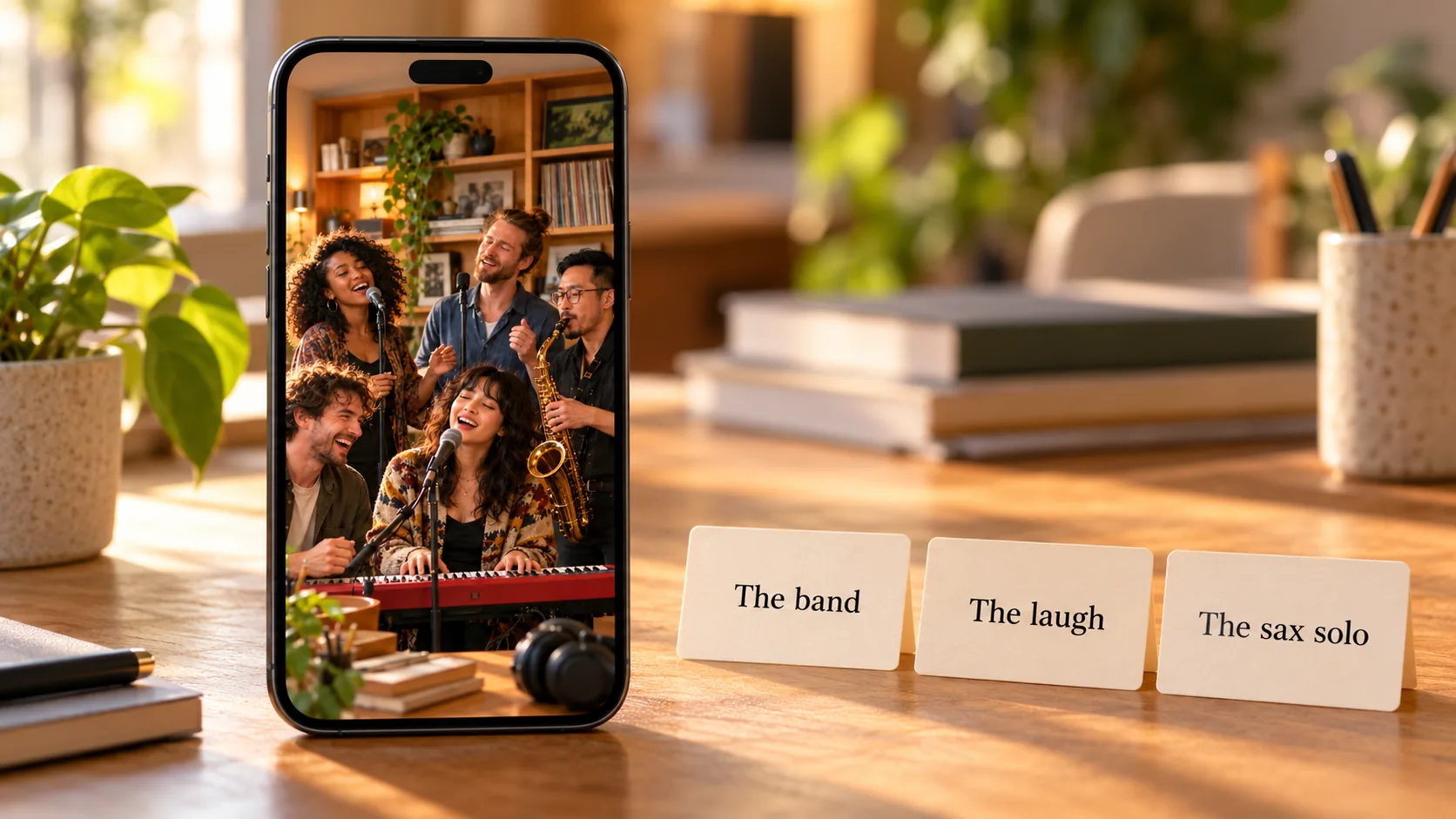
Different products cut that idea to different lengths. Some pages describe an 18- or 19-second edit with five shots. trytinydesk.video describes its own output as about 14 seconds, vertical 9:16, with three guided beats: the group, the laughing close-up, and the sax solo. If you are comparing generators, compare the cut they actually render. A longer timeline is not automatically the better joke. A tighter one can drop the shots that make the format recognizable. Fourteen seconds is enough for those three beats and short enough for TikTok, Reels, and Shorts without an edit.
The other distinction is whose face is allowed in the frame. The viral coach clips used public figures. Several generators, including this one, refuse that use. trytinydesk.video's upload rule, stated on the page, is that everyone pictured must be 18 or older, must have given permission, and must not be a celebrity or public figure. Reading about an All-Loss parody does not create a right to upload a coach, an owner, or a player. A fictional coaching staff made of consenting adults is a different project from a deepfake of a real one.
That boundary is the difference between a group joke and a fake news clip. The Tiny Desk audience is used to seeing real musicians in that room. A realistic face, a familiar desk, and a famous song can read as documentation if you do not label it. The tool's own FAQ says a generated video is an imagined desk concert, not footage of a real Tiny Desk appearance. The caption has to say the same thing.
Why a Tiny Desk AI Generator Exists at All
You can chase this trend three ways, and they fail differently.
A general video model will accept a prompt such as "Tiny Desk concert, soul band, saxophone." It will invent a room, a cast, and a camera move. It will not reliably reproduce the three-beat cut, and it has no idea which of your friends is supposed to laugh. Likeness drifts. Hands meet the keyboard in impossible ways. The horn multiplies. You spend the session negotiating with the model instead of casting the band.
A CapCut template or a manual editor can be closer, because you start from a real cut and drop faces in. The cost moves to your time. You are matching five heads to five shots, fixing the moments where a face slides off the laugh, and exporting a vertical file that still looks like a collage. Tutorials for that path spread alongside the meme, which is a clue: the edit is the hard part, not the idea.
A Tiny Desk AI generator is the narrow version of the job. The shot order, the length, the framing, and the soundtrack choice are already decided. Your work is the cast. That is a product decision, not a limitation to apologize for. The meme is a cover version of a camera script. Freezing the script is what makes five different friend groups recognizable as the same joke.
trytinydesk.video takes that narrow path and states the engine: Seedance 2.5, one render for the whole clip, original reference-clip sound or silence. There is no timeline, no CapCut project, and no prompt box for the scene. An optional note field accepts clothing direction only, and it has to start with the word "Outfit:". Anything else you might want to prompt, such as a different song, a different room, or a different joke, is outside the tool. If you want those, you want a general model, and you should expect to art-direct it.
How the Generator Casts the Band
The creator asks for one to five photos, in a fixed order. Each photo is one adult. A group photo is the wrong file, because the model then has to guess which face owns which role, and it will guess wrong in a way you cannot correct after the render.
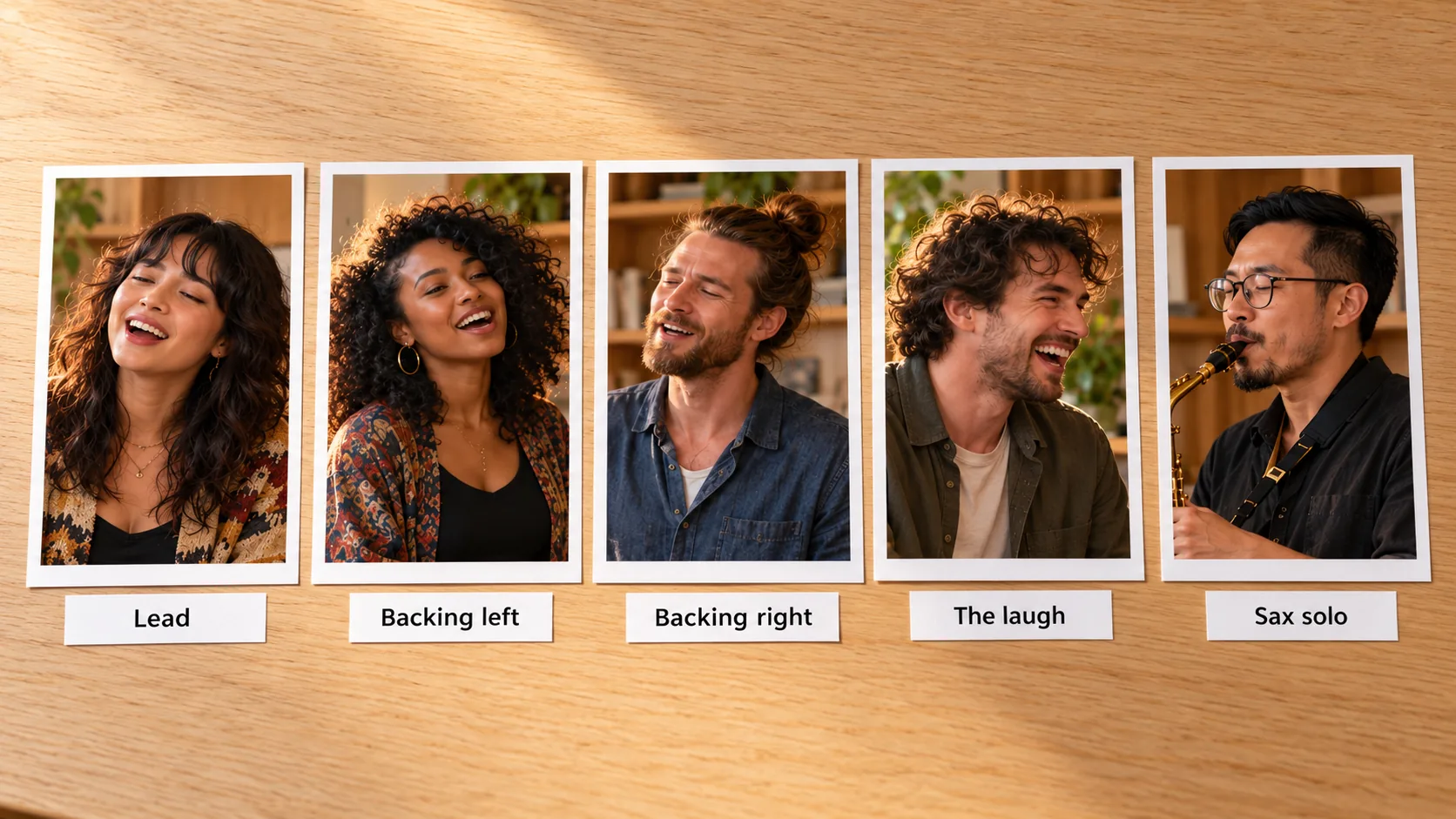
The five seats, as the site labels them:
- Lead singer. Seated at the microphone and the keyboard. This is the person the first wide shot is built around.
- Backing singer, left. Standing behind the lead, on the viewer's left.
- Backing singer, right. The matching voice on the other side.
- Laughing close-up. A separate performer. This is not an alternate crop of the lead. The meme's best second is a face that commits to the laugh, and the tool gives that face its own photo so you can cast it on purpose.
- Saxophone player. The final shot. This person does not need to play. They need a clear face. The instrument is the template's job, and it is also the detail most likely to look wrong, which is why you watch this shot before you post.
Fewer than five photos still runs. Empty seats are filled by people you already added, so a trio becomes a band by repetition rather than by inventing strangers. That is useful when only three friends agreed to be in the video. It is a weaker joke when you wanted five distinct people and simply forgot a file. The interface shows the count, up to five, before you spend credits. Use the count.
Two practical consequences follow from the numbering. First, upload order is the casting decision. Swapping photo two and photo four changes who gets the laugh, which changes the video more than any clothing note will. Second, the lead and the laugh can be the same person only if you upload them twice, in seat one and seat four. If you want the singer to also be the person who cracks up, that is a deliberate double cast, not the default.
The page also lets you add a short clothing note, capped at 500 characters, and only if it begins with "Outfit:". Matching black suits, team hoodies for a consenting amateur squad, or a single bright color are the kind of note that belongs there. A paragraph of scene direction does not. The room, the desk, the cuts, and the instruments are already in the reference.
Audio is a switch, not a mix. Original sound from the template's reference clip is on by default. Silent removes that soundtrack and leaves the picture. There is no third option to drop in a different master. If a platform later mutes the upload, the silent export is the file you already have, and you can attach whatever sound that platform offers. Attaching a platform sound does not transfer any right to use the recording somewhere else, and it does not turn the clip into an official performance. The site's FAQ is explicit on both points.
Before the render, the creator shows a credit quote. On October 30, 2026, the pricing page listed 10 credits for a 14-second 480p clip and 22 credits for the same clip at 720p. Failed renders return the credits. There is no free render and no free preview. New accounts are not described as carrying a starter balance.
Photos That Survive a Close-Up
The laugh shot is a face, large in the frame, for several seconds. Most of the quality advice collapses into that fact.
Use one adult per file, chest-up or front-facing, with the face large enough to see. Even light beats dramatic light. A window in front of the person is better than a window behind them. Sharp beats filtered. Sunglasses, masks, heavy beauty filters, and strong side angles all remove the information the model needs, and it will replace that information with a guess.
Skip the group photo even if everyone in it is willing. Cropping five faces out of one wide shot usually means five small, slightly different angles of the same room, which is a weak reference five times. Five separate portraits, even phone portraits, are a better cast list.
Resolution has a floor, not a fantasy ceiling. The creator accepts JPG, PNG, or WebP, up to 10 MB, and at least 300 by 300 pixels. A modern phone photo clears that easily. An old, heavily compressed social-media download often does not look like 300 pixels of useful face, even when the file dimensions pass. If you can see JPEG blocks across the eyes, the model can see them too.
Permission is a production step, not a checkbox to rush. The tool asks you to confirm that everyone pictured agreed, is 18 or older, and is not a celebrity or public figure. That confirmation is the minimum. The better version is a message in the group chat before you upload, with the role each person is taking, because "you are the sax solo" is a different favor from "you are in the background." People who would happily sing backup sometimes do not want the close-up. Ask before you assign seat four.
Review the finished file with the sound on and then off. AI video still misses. A hand can pass through the keyboard. A sax can change shape between frames. A backing singer can drift toward someone else's face. The site says likeness and timing can vary, and that is the correct expectation to carry into the download. If a face is wrong, render again with a clearer photo rather than trying to argue the clip into shape. The credit cost of a second 480p pass is the price of one more Single-pack clip, which is cheaper than posting a version that puts the wrong person on the laugh.
A Worked Cast, Without Using Anyone Famous
Imagine a five-person product team that just shipped a messy launch and wants the joke aimed at themselves. They do not upload their CEO from a press photo. They upload each other.
The person who ran the launch meeting takes the lead, because they already talk with their hands and the seated shot has a microphone. Two engineers who spent the week on the bug take backing left and backing right. The designer who kept saying "it's fine" gets the laugh, on purpose. The analyst who has never played an instrument gets the saxophone, because the mismatch is the punchline. Each person sends a plain portrait from a hallway with overhead lights, face forward, no sunglasses. Someone writes Outfit: matching navy sweaters in the notes. They pick original sound for the group chat, and they also export silent in case Instagram strips the audio.
That is the whole creative brief. The generator is not waiting for a better sentence. It is waiting for five faces that match five jobs.
A smaller version works when the group is three people. Put the strongest face on the lead, the most expressive face on the laugh, and the third person on one backing seat. Leave the other seats empty and let the tool reuse the cast. Do not invent a fourth and fifth person from celebrity photos to "complete the band." The empty-seat rule exists so you do not have to.
The All-Loss sports version can be told the same way if, and only if, the coaches are fictional and the faces are people who agreed. A weekend of amateur five-a-side, a fantasy league that went wrong, a rec-league staff in matching hoodies: those are casts you can actually permission. A screenshot of a televised sideline is not a cast. It is someone else's face, and this tool's rules exclude it.
What You Get Back, and Where It Goes
The download is a vertical MP4, about 14 seconds, watermark-free, saved to the account under My Creations. Watching and downloading saved clips does not cost more credits. Starting a render does. The page describes the first shot as the seated lead with two backing singers, the middle shot as the separate laughing performer, and the last shot as the saxophone. That three-part shape is the thing to check against the meme before you look at anything else. If the laugh is missing, or the sax never arrives, the file is not done, however good the faces look.
Posting is a separate set of decisions from generating.
Label it as AI-generated where the platform asks. TikTok, Instagram, and YouTube all have realistic-AI labels, and a clip this convincing is exactly the case those labels are for. A joke that depends on people recognizing a parody still needs the label. The audience can be in on the joke and still be owed the disclosure.
Write a caption that names the real subject of the joke. "Outstanding" on its own is just the song. "The on-call rotation after the Friday deploy" tells a coworker why these five faces are the band. The first second is the group or the lead, so do not put a title card in front of it. The hook is the face.
Keep the silent file. Original sound is what makes the clip feel like the meme inside a group chat. On a public platform, music rights are enforced by the platform, not by the generator. A muted upload is a normal outcome, not a broken render. The silent export is how you still post the picture and attach a sound the platform already licenses to that post. Do not assume that a soundtrack which played in your downloaded MP4 will play for everyone else.
Do not present the file as a real Tiny Desk session, a real Charlie Wilson appearance, or an official release. The humor survives the disclosure. The disclosure is what keeps the humor from becoming a counterfeit.
What the Clip Costs
trytinydesk.video's pricing page, as it read on October 30, 2026, sells credits rather than a single locked quality. A 14-second Seedance 2.5 clip is 10 credits at 480p and 22 credits at 720p. One-time packs do not renew, and those credits are described as never expiring. Monthly plans add a fresh balance each billing period and renew until you cancel under Settings, then Billing.
| Pack or plan | Price | Credits | Roughly, at 480p |
|---|---|---|---|
| Single, one-time | $9.99 | 10 | 1 clip |
| Trio, one-time | $19.99 | 30 | 3 clips |
| Duo, one-time | $29.99 | 55 | 5 clips |
| Crew, one-time | $99 | 350 | 35 clips |
| Studio pack, one-time | $199 | 900 | 90 clips |
| Basic, monthly | $29.90 | 70 / month | 7 clips |
| Pro, monthly | $49.90 | 200 / month | 20 clips |
| Studio, monthly | $99.90 | 600 / month | 60 clips |
Those "roughly" figures are 480p math. A 720p clip costs 22 credits, so the $9.99 Single pack does not cover it. The Trio pack, at 30 credits, covers one 720p clip and leaves a small remainder. If you know you want the sharper file for a public post, price 22 credits, not 10. If you are sending a draft around a group chat to see who laughs, 480p is the cheaper way to find out the cast is wrong.
The per-clip price falls hard once you leave the Single pack. Trio lands near $6.66 a 480p clip. The Studio monthly plan lands near $1.67. That spread only matters if you will actually render the extra clips. A five-person joke needs one good take, plus maybe one redo when the saxophone bends. Thirty credits covers that experiment at 480p with room for a 720p final. Nine hundred credits is a posting schedule, not a weekend.
Checkout is handled by a third-party payment provider. The site says it does not store the card number. Packs charge once. Plans renew until you turn renewal off, and you keep the period you already paid for. Yearly plans, where offered, drop the full year's credits in at the start. Refunds for a payment, as opposed to an automatic credit return on a failed render, go through the refund policy: write to support@trytinydesk.video with the account email and the payment reference.
Commercial use is conditional. The FAQ says you can put your own generated clips into paid work where the plan you bought lists a commercial-use license. You still need rights to every photo, and the post still cannot imply an endorsement by NPR, Tiny Desk Concerts, Charlie Wilson, The Gap Band, or anyone else. If the plan page in front of you does not mention that license, do not assume the Single pack includes it.
What This Tool Will Not Do
It will not make the rest of the concert. "Computer Love," "I'm Blessed," and the gospel stretch in the middle are not templates here. The product is the Outstanding ending, cut down to the three beats.
It will not take a celebrity, a minor, or a person who did not agree. The upload rules are on the creator, and they are repeated in the FAQ. A trend article is not permission.
It will not guarantee a face. Seedance 2.5 is a video model being asked to hold several identities across cuts while a performance moves. That is a harder problem than a still portrait. Budget for a second render if the laugh shot softens the eyes or the sax player's face drifts toward the lead.
It will not clear the song for you. Original sound from the reference clip is a feature the site offers inside its own export. It is not a sync license you can carry onto a television ad, a paid brand deal, or a soundtrack album. When in doubt, use the silent file and stay inside the platform's own audio library. This is not legal advice. It is a description of the boundary the product itself draws.
It is not an official Tiny Desk tool. The FAQ answers this in one line, and it is worth quoting in spirit: trytinydesk.video is an independent fan-made parody tool, with no affiliation to NPR, the concert series, the singer, or the band. The desk in your clip is an imagined one.
How to Judge a Finished Tiny Desk AI Video
Play it once for the joke and once as a critic. The first pass tells you whether the cast is funny. The second pass is a checklist.
The lead should still look like the person in photo one when the shot is wide, not only in a freeze frame. Backing singers should stay on their own sides. The laugh should be a performance, not a smear, and it should be the person from photo four. The saxophone should remain one instrument, in one pair of hands, through the final shot. Clothing should be close to the outfit note if you wrote one, and wildly off only if you left the note blank and the template dressed them.
Then check the cut. A good Outstanding Tiny Desk AI video feels like three shots with a reason, not a single zoom with faces pasted on. If the phone preview looks like a still that wobbles, the render missed the camera grammar that makes the meme legible. That is worth a redo. If the faces are right and the cuts are right and only a finger looks strange for two frames, you are probably looking at a shippable joke, provided you label it.
Show it to the people in it before you post it anywhere public. A group chat is a smaller audience than a TikTok account with the song attached, and the second audience cannot be unsent as easily. The person on the laugh should see the laugh.
Where the Keywords Meet
Tiny Desk AI is the trend name. A Tiny Desk AI generator is the kind of product that fixes the cast, the length, and the soundtrack so you do not rebuild the edit. A Tiny Desk AI video is the file: short, vertical, three beats, labeled as AI. Outstanding Tiny Desk AI names the song and the joke together. Charlie Wilson Tiny Desk AI names the 2023 concert that the joke is quoting.
Those phrases get used as if they were five products. They are one cultural object, plus a pile of tools of uneven narrowness. The useful question is which part of the object a given site actually makes. On the evidence of its own creator and pricing pages, trytinydesk.video makes one thing: a 14-second Seedance 2.5 desk-concert parody from one to five permitted photos, at 10 credits in 480p or 22 credits in 720p, with the reference soundtrack or without it. The concert it quotes is real, public, and worth watching in full. The clip it makes is a parody, and it should go into the world looking like one.