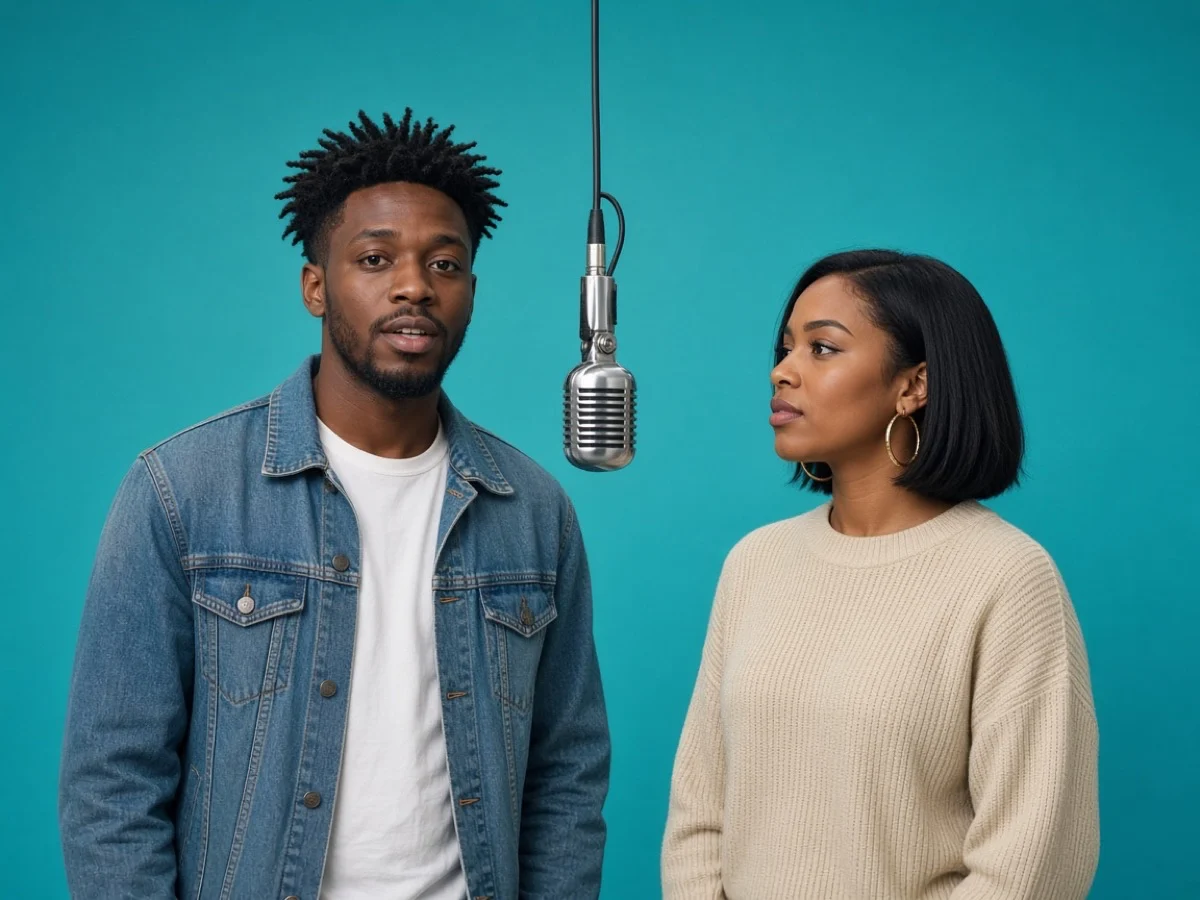
A 58th Floor AI video is a fifteen-second duet in a teal studio. Two people, or a person and a pet, stand under one vintage microphone on a long cable. The first finishes the hook. The second takes the verse. Mouths move with the record. The file is vertical, built for TikTok, Reels, and Shorts. Search bars split that one object into several names. 58th Floor AI, 58th Floor AI Video Generator, 58th Floor AI Trend, 58th Floor AI Video From Two Photos, and 58th Floor AI Filter all point at the same clip, and they do not point at a skyscraper, a penthouse, or a camera effect you tap inside TikTok.
This guide walks through that clip on purpose. The worked example is 58th Floor AI, the browser tool at 58thfloorai.video. On November 4, 2026, its maker page described a fan-made generator that takes two photos and returns about fifteen seconds of 9:16 MP4, at 480p or 720p, with the original sound or a silent export. It is an independent product. It is not Anderson .Paak, not Cordae, not their labels, and not COLORS. A generated file is a new video made from your photos. It is not an edit of the COLORS performance, and it is not an appearance on that show. This page is a guide published on happyhorse2.video. Happy Horse 2 does not render this template.
What those five searches are asking for
People arrive with different words and the same job.
58th Floor AI is the short name. It covers the trend and the pile of sites that now sell a version of it. Used alone, it is ambiguous, because the song title sounds like an address. A tool that answers with a glass apartment has read the words as a floor number. The videos spreading on phones are a studio performance.
A 58th Floor AI Video Generator is the phrase used when someone wants the file, not the history. They have seen the teal wall and the hanging mic, and they want an MP4 of two specific faces in that room. The useful generators do not ask for a scene prompt. The room, the cuts, and the lip-sync are already the product. You supply the cast.
The 58th Floor AI Trend is the cultural object: the COLORS session, then the week of copies. A trend guide that never names the song, the date, or the four shots will send a reader to the wrong template. Hotel Lobby is the usual mix-up. That format is an orange booth, a different song, and different artists. The 58th Floor room is teal, and the prop is one microphone between two people.
58th Floor AI Video From Two Photos is the practical version of the request. The input is the whole trick. One photo per person. Photo one stands on the left and finishes the hook. Photo two stands on the right, takes the verse, and gets the close-up. A group selfie with both people in one frame is the upload most likely to blend the faces, because the generator is built to cast exactly two identities from two files.
58th Floor AI Filter is the name people use when they expect a lens, a CapCut template, or a TikTok effect. The product page is direct about this. There is no camera filter for the clip. The videos are rendered from stills. CapCut can still trim or caption the MP4 afterwards. It is not required to create the duo, the studio, or the lip-sync. If a template only lays out footage you already shot, it is an editor, and it will not invent the second person from a selfie.
Those five phrases get treated as five apps. On the pages that rank for them, they are one format plus a set of tools that disagree on length, resolution, pets, soundtrack, and the smallest amount of money that buys one clip. A how-to that ignores the disagreement will send someone through the wrong checkout. This one stays on a single maker, read on November 4, 2026, and it says when a figure comes from that maker's own comparison rather than from a fresh test of every rival.
The session the trend is quoting
"58th Floor" is a song title. It is the opening track of Heavy Is the Crown, the joint album Anderson .Paak and Cordae released on October 23, 2026. The product's own song note says a credit list cited from Qobuz names J. Cole as producer, and it says Apple Music describes the track as a comedic story built around a phone call, with the two artists building on each other's lines. The recording contains explicit language. That last fact matters before you post, because the default export keeps the recording on the file.
COLORS posted a performance of the song on October 30, 2026. The COLORS streaming page for the session is the official route to that recording. The staging is the part a still can explain. A seamless teal-turquoise studio. Soft, almost shadowless light. One vintage microphone hanging from a cable between the two of them. Anderson .Paak closes the hook. Cordae takes the verse. The full session is a performance, with comic business a fifteen-second template does not restage. View counts for that upload moved quickly in the first days, and this guide does not treat any one of those numbers as settled. What settled is the look people started asking generators to copy: the teal wall, the hanging mic, the handoff.
The handoff is why two photos are enough, and why one photo is the wrong shape. The joke, or the compliment, is the pairing. One person sets up the line. The other answers it. Friends, partners, siblings, and coworkers fit that structure because the viewer already knows the relationship, and the caption only has to say who took the verse. A solo portrait can be a different video. It is a different template on the sites that offer one. The format this page is about is a duo: two people, two pets, a person and a pet, or the same consenting adult used twice.
The AI version keeps the room and the cuts, then swaps the cast. Faces, hair, and clothes come from the uploaded photos. The product page says the render does not dress your subjects in a celebrity's cap, chain, or sunglasses. That is a likeness rule and a consent rule at the same time. Uploading Anderson .Paak, Cordae, or any other public figure is off-limits on this maker. The artists performed the session. A generator that pastes their faces onto a new file is a different, and prohibited, project.
The four shots, timed
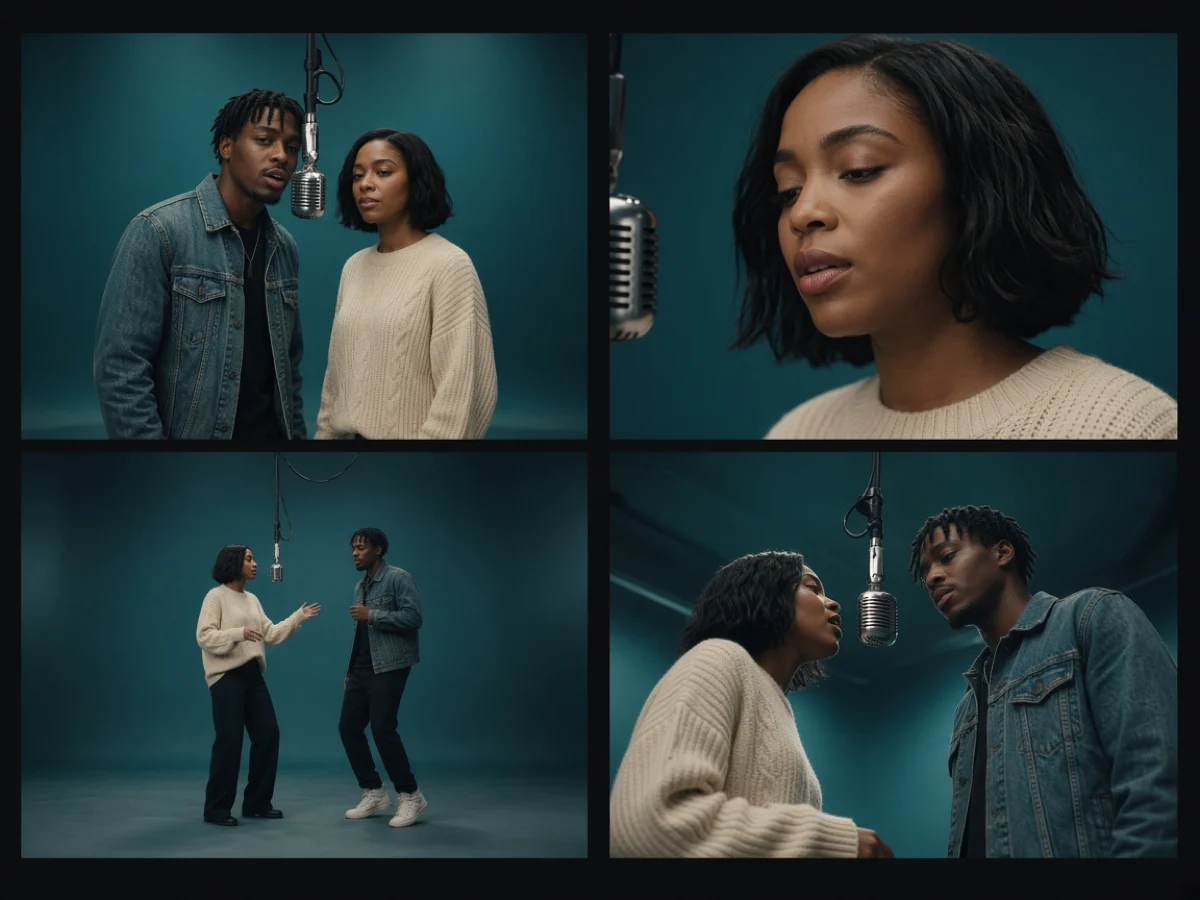
58th Floor AI times every clip to the same four cuts. The page lists them against the song, and a render that drops one of them has missed the format even if the wall is the right color.
From 0 to 5.5 seconds, the frame is a waist-up two-shot. Photo one raps the end of the hook toward the camera. Photo two stands beside the mic with a closed mouth and turns toward photo one at about 3.5 seconds. This is the shot people screenshot. If the likeness is weak here, the close-up later cannot repair the joke, because this is the frame that says "these two, this room."
From 5.5 to 8.7 seconds, the camera moves to a close-up of photo two. Eyes half closed, the microphone at the edge of the frame, and only that person in shot. This is why the verse slot is a casting decision and not a default. The second photo gets the solo. Put the person who should have the last word, or the punchline, in photo two. If you wanted yourself in that close-up, you are photo two, and your friend is photo one.
From 8.7 to 11.5 seconds, the frame opens to a head-to-toe wide shot on the teal stage. Photo two keeps rapping. Photo one bounces beside them, mouth closed. Clothes and shoes become visible here, which is why a chest-up selfie can still work and a photo that includes more of the body gives the wide shot more to keep. The model has to invent a stance either way. A photo that already shows the outfit you want gives it less to invent.
From 11.5 to 15 seconds, the camera drops into a low two-shot. Photo two, in profile, raps toward photo one. Photo one nods, with the kind of impressed face the original session uses when the verse lands. Fifteen seconds is long enough for the handoff and short enough to post without a second edit. A thirty-second cut exists on other sites. It is a different file. When you compare generators, compare the cut they actually render.
How to make the clip
Everything described here happens in the browser. There is no app to install and no scene prompt to write. The page is explicit that the studio, the shots, and the lip-sync stay fixed. A sentence about a different song, a different room, or a skyscraper is outside the tool. If you want those, you want a general model, and you should expect it to miss this cut.
Open 58th Floor AI on a phone or a desktop. Safari and Chrome are the browsers the site names. On a phone, the photos can come straight from the camera roll, and the finished MP4 can be saved to Photos.
Cast the two roles
The upload order is the cast list.
- Rapper one, on the left. This person finishes the hook, then stays beside the mic with a closed mouth while the other takes over.
- Rapper two, on the right. This person takes the verse, gets the close-up, and raps toward photo one in the last shot.
One consenting adult, or one pet, per photo. JPG, PNG, or WebP. Up to 10 MB. At least 300 by 300 pixels. Separate selfies are enough. They do not need to be from the same day or the same room. They need to be one identity each, with the face visible.
Check the slots before you spend credits. Photo one always finishes the hook. Photo two always takes the verse. Swapping them after the render means another render. The maker shows the credit total on the button before you confirm. A render that fails, or that a safety check blocks, is described as returning its credits on its own.
Pick the model, the resolution, and the sound
Two models were listed on November 3, 2026. Standard renders on Seedance 2.0 Fast. Pro renders on Seedance 2.5, which the site identifies as the model Starrd uses for its own 58th Floor template. Standard is the lower credit cost. Pro is the tier to choose when the faces and the motion need to hold up full screen. Both tiers offer 480p and 720p. Both are vertical MP4 files, and paid downloads are described as carrying no watermark.
Sound has two settings, and they are easy to choose backwards. Original sound is the default. The mouths are synced to the "58th Floor" recording, and that recording stays on the file. It contains explicit language. Silent exports the same picture without that soundtrack, so you can attach a sound inside TikTok, Instagram, or YouTube if that sound is available there. The page does not offer a custom song, a lyric change, or a voice clone of the person in the photo. Mouth movement is generated against the reference. A track you drop on later will not match the mouths with the same tightness, because the default was rendered to the original. If the joke depends on the performance audio, leave the default on. If the joke depends on a caption and a different audio page, export silent.
A director's note is optional. The field shown on November 4, 2026, held 500 characters. The example on the page was "Both in matching denim jackets." The note is for outfits, sunglasses, or a prop. It does not move the camera, change the teal wall, or rewrite the four shots. If the sentence you want to type is about the plot, it belongs in the caption, not in the note.
Watch it, then post it as a new video
The finished file is described as landing on the page and in My Creations, where it can be replayed and downloaded later. Replay and download do not spend credits. Only starting a render does. The site says a render takes a few minutes.
Watch all fifteen seconds before you send it. The handoff, the close-up mouth, the hands in the wide shot, and the profile in the last frame are the usual places a render goes strange. A second take is a normal part of this format, which is why the pricing page sells packs larger than one clip. Do not post the first file if a face slides or a hand melts during the verse. The clip is short enough that viewers notice.
Label the post as AI-generated. TikTok, Instagram, and YouTube ask for that label on realistic AI video. The room this format quotes is a real COLORS session, and a realistic face in that room can read as documentation. The caption has to say the clip is generated, in plain language. Do not tag it as if Anderson .Paak, Cordae, or COLORS made it, hosted it, or endorsed it. They did not.
Photos, pets, and the note that does not redirect the scene
The page's photo notes are stricter than a typical social upload, and they change the result more than the resolution toggle.
Use one face per frame, chest up or front-facing, in even light. Crop other people out of a group photo before you upload it. A second face at the edge becomes a second identity the model may try to honor, which is how blended faces happen. Sunglasses, masks, low hats, and heavy filters are where likeness slips first, because the model has to invent the eyes or the jaw. A window in front of the person is enough light. A steep angle from below is the shot most likely to come back as a different person who happens to share a haircut.
The source expression matters more for photo two than for photo one. Photo two has to rap, half-close the eyes, and hold a profile. A sharp, front-facing photo still gives the model a face to keep. A photo where the mouth and the eyes are already readable gives it more. For the wide shot, a picture that shows the clothes you want is better than a note that asks the model to change them. The clip uses what each photo shows. A director's note can request a jacket. It is a weaker instruction than a photo of the jacket.
Ask before you cast. The checkbox next to the button says you have permission from everyone pictured, that everyone is 18 or older, and that nobody pictured is a celebrity or a public figure. That includes the artists whose session is being quoted. Minors are off-limits. Nudity and other prohibited material are stopped by automated checks, and a blocked render returns the credits. A friend who agreed, a partner who agreed, or a coworker who agreed to a launch-day joke is the project this tool is built for.
Pets are a supported cast, not a workaround. Either slot can be a dog or a cat, and both slots can be animals. The product's pet page says the animal stands upright at the hanging mic with its own paws, fur, and markings, that its mouth moves only during its part, and that human hands are not added to animals. Dogs and cats are described as the reliable cases, because their faces read clearly. Other animals can be tried, with more variation between renders. The useful pet photo is eye-level, one animal, face filling the frame, nothing over the muzzle. A photo taken from above, with the dog looking at the floor, gives the model a skull shape and no expression.
The same adult twice is allowed. That produces one person answering themselves, which can be the joke. It is still two uploads. Leaving a slot empty is not described as an option on this maker. Two files, two identities, even when the identity is repeated on purpose.
What the credits buy
The pricing block on the maker, as it read on November 4, 2026, sells credits rather than a single locked quality. The button shows the total before you confirm. These are the figures printed that day. They can change. A later page beats this paragraph. The site's own changelog on November 3 said the Single pack had moved to $6.99, and that Standard and Pro were the two models.
One-time packs do not renew. Unused pack credits stay until you spend them. There is no free render. A failed or blocked render returns the credits charged for that job. That return is a credit on the balance, which is the refund the FAQ describes. Watching a finished clip does not charge you again.
A Standard 15-second clip uses 10 credits at 480p and 22 credits at 720p. A Pro clip uses 25 credits at 480p and 55 credits at 720p. The "about N clips" lines on the packs are Standard 480p counts.
- Single: 10 credits, $6.99. One Standard 480p clip. It does not cover 720p, and it does not cover Pro.
- Trio: 30 credits, $14.99. Three Standard 480p clips, or one Standard 720p clip with 8 credits left. Those 8 credits are not another clip at either Standard resolution. One Pro 480p clip uses 25 and leaves 5.
- The 55-credit pack: $24.99, listed at about $4.54 per Standard 480p clip, and described as about five clips. The arithmetic is five Standard 480p renders with 5 credits left, or two Standard 720p renders with 11 left, or two Pro 480p renders with 5 left, or one Pro 720p render exactly.
Larger one-time packs and monthly plans are on the same page. The monthly figure printed in full on November 4 was Basic: 70 credits a month, $29.90, about seven Standard 480p clips. Three Standard 720p renders are 66 credits, so Basic covers them with a little left. One Pro 720p render is 55, which leaves 15, enough for one more Standard 480p and not enough for a Standard 720p. The arithmetic is worth doing before you pick a plan for a weekly pairing, because a 720p habit and a Pro habit burn the balance on different clocks.
Credits from packs are described as never expiring. Monthly plans are a different product: a fresh balance each period, renewing until you turn renewal off. If you expect to make one clip, the Single pack matches the job. If you expect a retake, Trio is the pack that assumes the first render might be the draft.
When the render misses
Most misses come from the photos, and most are fixed by changing one of them.
Blended faces usually mean one photo contained both people. Crop each person into a file of their own and render again. The generator is not a group-photo editor. It casts two slots.
The wrong person rapping first means the files are in the wrong slots. Photo one finishes the hook. There is no switch inside the finished video. Swap the uploads.
A face that does not look like the person is usually focus, light, or something covering the face. Use a sharper front-facing photo, without sunglasses or a heavy filter. Resolution will not invent a likeness the still never provided. Pro can sharpen motion. It cannot recover an eye the source photo hid.
A pet that looks odd is usually the angle or the muzzle. Eye level, one animal, face large. If a human hand appears on a dog, that render has missed the rule the pet page states, and it is a retake, not a caption.
Clothes that change are the model inventing a body the photo did not show. Pick a photo in the outfit you want, or add a short director's note and accept that the note is weaker than the photo. The wide shot is where a wardrobe miss becomes obvious, because the frame includes the shoes.
A safety filter can stop a realistic photo that breaks no rule you intended. The credits come back. Try a different still. Do not keep submitting the same blocked file.
If the wall is teal and the mic is there, but the cuts are a single unchanging two-shot, you are not looking at this template. The four timings above are the checklist. Play the file once with the sound on and once while you watch only the mouths. The person who is not rapping should keep a closed mouth. A verse in which both mouths move the whole time has missed the handoff, which is the point of the duo.
Sound, caption, and the label
The clip can be posted as it is. A few choices decide whether it reads as a duet or as a random studio.
Leave the original sound on when the lip-sync is the joke. Choose Silent when you need a version without the explicit recording, or when you plan to use a sound the platform already hosts. Silent is also the export to pick if a platform mutes the embedded track and you would rather attach audio in the app than ship a clip whose mouths match a song nobody can hear.
Say who took the verse. The product's own caption example is the shape to copy: a sentence about the relationship, not a sentence that claims a feature. "When your best friend takes the verse uninvited" tells a viewer how to watch the close-up. A caption that only stacks tags tells them nothing. The site lists #58thfloor, #58thflooraitrend, #andersonpaak, #cordae, and #colorsshow as tags people use. Use them as topic labels. They are not credits, and they are not permission.
Turn on the AI-generated label where the platform asks. Then watch the clip on a phone, at the size it will actually be seen. A 480p file is the one the $6.99 pack buys, and it matches a feed. A 720p file is the one to choose when the close-up is the whole screen and the face has to hold. It costs 22 Standard credits, a bit more than twice the 480p job, so a balance that makes two 480p clips does not make two 720p clips.
Why a general video studio will not lock this cut
Some of the traffic around this trend lands on an open prompt instead of a template. Happy Horse 2, the studio publishing this guide, is one of those workspaces. It runs in the browser. You start from a photo or a short written idea, describe the movement, and the job goes to a third-party engine: Google Veo 3.1, OpenAI Sora 2, or ByteDance Seedance 1.5 Pro. It also offers reference-to-video and a frames-to-video option with an opening frame and a closing frame. That is a coherent product for a product photo that should turn, a portrait that should glance, or a storyboard panel that needs a motion test. It does not ship a two-slot teal-studio form with the verse already placed at 5.5 seconds.
The words "58th floor" are a trap in an open prompt. The product's own prompt note says that phrase alone tends to produce a high-rise apartment, because the model hears a floor number. Even a careful prompt that names the teal wall, the hanging mic, and the handoff still has to keep the correct mouth moving at the correct time, across four cuts, for fifteen seconds. Template sites do that staging for you. A general model can get close, and it usually takes several paid tries, with the song added afterwards. Seedance 1.5 Pro, the engine Happy Horse 2 can route to, is not the Seedance 2.0 Fast or Seedance 2.5 job this template names. Sharing the word Seedance does not make the cuts the same.
Use a studio when you want to direct an original scene. Use the maker when you want this handoff, these four shots, and this soundtrack toggle. Hoping a general model will reproduce the COLORS cut from the title is how people spend several renders and still post a penthouse.
Which generator fits the job
By November 3, 2026, the format was no longer a single site. 58th Floor AI's comparison of the apps, updated that day, names six template sites that put two people in the teal studio with one hanging mic: Starrd, MakeViral, VideoSi, Flowlio, AI Meme Videos, and 58th Floor AI. The page says it copied each tool's photos, length, sound, model, and price from that tool's own 58th Floor page on November 3, and it says the figures move. Read them as a snapshot, then read the checkout you are about to use.
The differences that change the job are short. Starrd is described as the earlier Seedance 2.5 template, at 480p, with a 30-second extended cut and pets, at about $7.50 for the 15-second file. MakeViral is described as offering duo, solo, and pet versions at 720p, with a smallest pack of $39.99 that covers one clip. VideoSi is described as a 13-second 720p cut, with packs from $6.99. Flowlio is described as offering 15-second, 30-second, and wide 16:9 versions, plus some free credits on sign-up, and as not supporting pets. AI Meme Videos is described as several model tiers, with plans from $29.90 a month. 58th Floor AI's page describes its own offer as Standard from 10 credits on the $6.99 Single pack, Pro from 25 credits, pets in either slot, a Silent export, 720p, and pack credits that do not expire.
The ten-second choice on that page is the useful one. One cheap Standard clip: 58th Floor AI or VideoSi. Starrd's model, including at 720p: Starrd, or 58th Floor AI Pro. A 30-second cut: Starrd or Flowlio. A dog or a cat: 58th Floor AI, Starrd, or MakeViral. A file without the explicit recording: the Silent option on 58th Floor AI. None of these sites is the official performance. A free tutorial, a watermarked preview, or a template layout is not the same thing as a downloadable video of the two people in the photos.
If you only need one duet, cast it before you buy a monthly plan. Decide who finishes the hook and who takes the verse. Use two sharp photos of consenting adults, or of pets whose faces you can actually see. Read the credit number on the button. Render. Watch the four shots in order. Label the post. The trend is the handoff. The generator is finished when a viewer can tell, without a caption, which of the two just took the verse.